

Meteoritical Database: Search Official Meteorite Names
Search tens of thousands of officially recognized meteorites, and learn how naming works.
Photo: Hoba meteorite, Namibia (2014) — Olga Ernst, CC BY-SA 4.0, via Wikimedia Commons
Every recognised meteorite has an official name, approved by the Meteoritical Society and published in the Meteoritical Bulletin. Its database is the world’s reference list of meteorites. Below you can search Meteorite World’s copy of 61,706 official entries, then open any meteorite’s full record on the official Bulletin site.
Search meteorites
| Name | Class | Mass | Fall / find | Year | |
|---|---|---|---|---|---|
| Grosvenor Mountains 95631 | L6 | 80 g | Find | 1995 | Official record ↗ · Map |
| Grosvenor Mountains 95634 | L6 | 120 g | Find | 1995 | Official record ↗ · Map |
| Grosvenor Mountains 95635 | L6 | 76 g | Find | 1995 | Official record ↗ · Map |
| Grosvenor Mountains 95636 | L6 | 126 g | Find | 1995 | Official record ↗ · Map |
| Grosvenor Mountains 95637 | L6 | 293 g | Find | 1995 | Official record ↗ · Map |
| Grosvenor Mountains 95638 | L6 | 91 g | Find | 1995 | Official record ↗ · Map |
| Grosvenor Mountains 95639 | L6 | 82 g | Find | 1995 | Official record ↗ · Map |
| Grosvenor Mountains 95640 | L6 | 33 g | Find | 1995 | Official record ↗ · Map |
| Grosvenor Mountains 95642 | L6 | 9.5 g | Find | 1995 | Official record ↗ · Map |
| Grosvenor Mountains 95643 | L6 | 12 g | Find | 1995 | Official record ↗ · Map |
| Grosvenor Mountains 95644 | L6 | 10 g | Find | 1995 | Official record ↗ · Map |
| Grosvenor Mountains 95646 | L6 | 8.6 g | Find | 1995 | Official record ↗ · Map |
| Grosvenor Mountains 95648 | L6 | 94 g | Find | 1995 | Official record ↗ · Map |
| Grosvenor Mountains 95649 | L6 | 89 g | Find | 1995 | Official record ↗ · Map |
| Grosvenor Mountains 95650 | L6 | 84 g | Find | 1995 | Official record ↗ · Map |
| Grosvenor Mountains 95653 | L6 | 59 g | Find | 1995 | Official record ↗ · Map |
| Grosvenor Mountains 95656 | L6 | 27 g | Find | 1995 | Official record ↗ · Map |
| Grosvenor Mountains 95657 | L6 | 21 g | Find | 1995 | Official record ↗ · Map |
| Grosvenor Mountains 95660 | L6 | 132 g | Find | 1995 | Official record ↗ · Map |
| Grosvenor Mountains 95661 | L6 | 17 g | Find | 1995 | Official record ↗ · Map |
| Grosvenor Mountains 95662 | L6 | 112 g | Find | 1995 | Official record ↗ · Map |
| Grosvenor Mountains 95663 | L6 | 43 g | Find | 1995 | Official record ↗ · Map |
| Grosvenor Mountains 95665 | L6 | 127 g | Find | 1995 | Official record ↗ · Map |
| Grosvenor Mountains 95666 | L6 | 67 g | Find | 1995 | Official record ↗ · Map |
| Grove Mountains 020020 | L6 | 2.6 g | Find | 2002 | Official record ↗ · Map |
| Grove Mountains 020027 | L6 | 429 g | Find | 2002 | Official record ↗ · Map |
| Grove Mountains 020046 | L6 | 3.0 g | Find | 2003 | Official record ↗ · Map |
| Grove Mountains 020053 | L6 | 11 g | Find | 2003 | Official record ↗ · Map |
| Grove Mountains 020056 | L6 | 5.5 g | Find | 2003 | Official record ↗ · Map |
| Grove Mountains 020061 | L6 | 6.6 g | Find | 2003 | Official record ↗ · Map |
| Grove Mountains 020062 | L6 | 2.3 g | Find | 2003 | Official record ↗ · Map |
| Grove Mountains 020063 | L6 | 2.9 g | Find | 2003 | Official record ↗ · Map |
| Grove Mountains 020073 | L6 | 9.0 g | Find | 2003 | Official record ↗ · Map |
| Grove Mountains 020081 | L6 | 5.0 g | Find | 2003 | Official record ↗ · Map |
| Grove Mountains 020095 | L6 | 6.1 g | Find | 2003 | Official record ↗ · Map |
| Grove Mountains 020103 | L6 | 19 g | Find | 2003 | Official record ↗ · Map |
| Grove Mountains 020115 | L6 | 8.3 g | Find | 2003 | Official record ↗ · Map |
| Grove Mountains 020131 | L6 | 3.8 g | Find | 2003 | Official record ↗ · Map |
| Grove Mountains 020132 | L6 | 1.9 g | Find | 2003 | Official record ↗ · Map |
| Grove Mountains 020134 | L6 | 16 g | Find | 2003 | Official record ↗ · Map |
| Grove Mountains 020138 | L6 | 2.3 g | Find | 2003 | Official record ↗ · Map |
| Grove Mountains 020141 | L6 | 0.9 g | Find | 2003 | Official record ↗ · Map |
| Grove Mountains 020142 | L6 | 1.1 g | Find | 2003 | Official record ↗ · Map |
| Grove Mountains 020143 | L6 | 2.3 g | Find | 2003 | Official record ↗ · Map |
| Grove Mountains 020151 | L6 | 1.5 g | Find | 2003 | Official record ↗ · Map |
| Grove Mountains 020152 | L6 | 2.5 g | Find | 2003 | Official record ↗ · Map |
| Grove Mountains 020155 | L6 | 612 g | Find | 2003 | Official record ↗ · Map |
| Grove Mountains 020161 | L6 | 7.6 g | Find | 2003 | Official record ↗ · Map |
| Grove Mountains 020163 | L6 | 3.4 g | Find | 2003 | Official record ↗ · Map |
| Grove Mountains 020167 | L6 | 7.5 g | Find | 2003 | Official record ↗ · Map |
Data from the Meteoritical Bulletin Database (Meteoritical Society, hosted by the Lunar and Planetary Institute). Our copy is updated periodically and may not include the newest approvals. The official database is the authority.
How meteorites are named

A meteorite is named after the place where it fell or was found, usually a nearby town, farm or natural feature: Allende, Murchison, Hoba. Where many meteorites come from the same small area, the name is a place name plus a number:
- Hot deserts with recorded find coordinates are divided into named areas, for example Dhofar 1653 in Oman or Acfer 048 in Algeria.
- NWA (Northwest Africa) is used for meteorites from the Sahara whose exact find site is unknown, for example NWA 869.
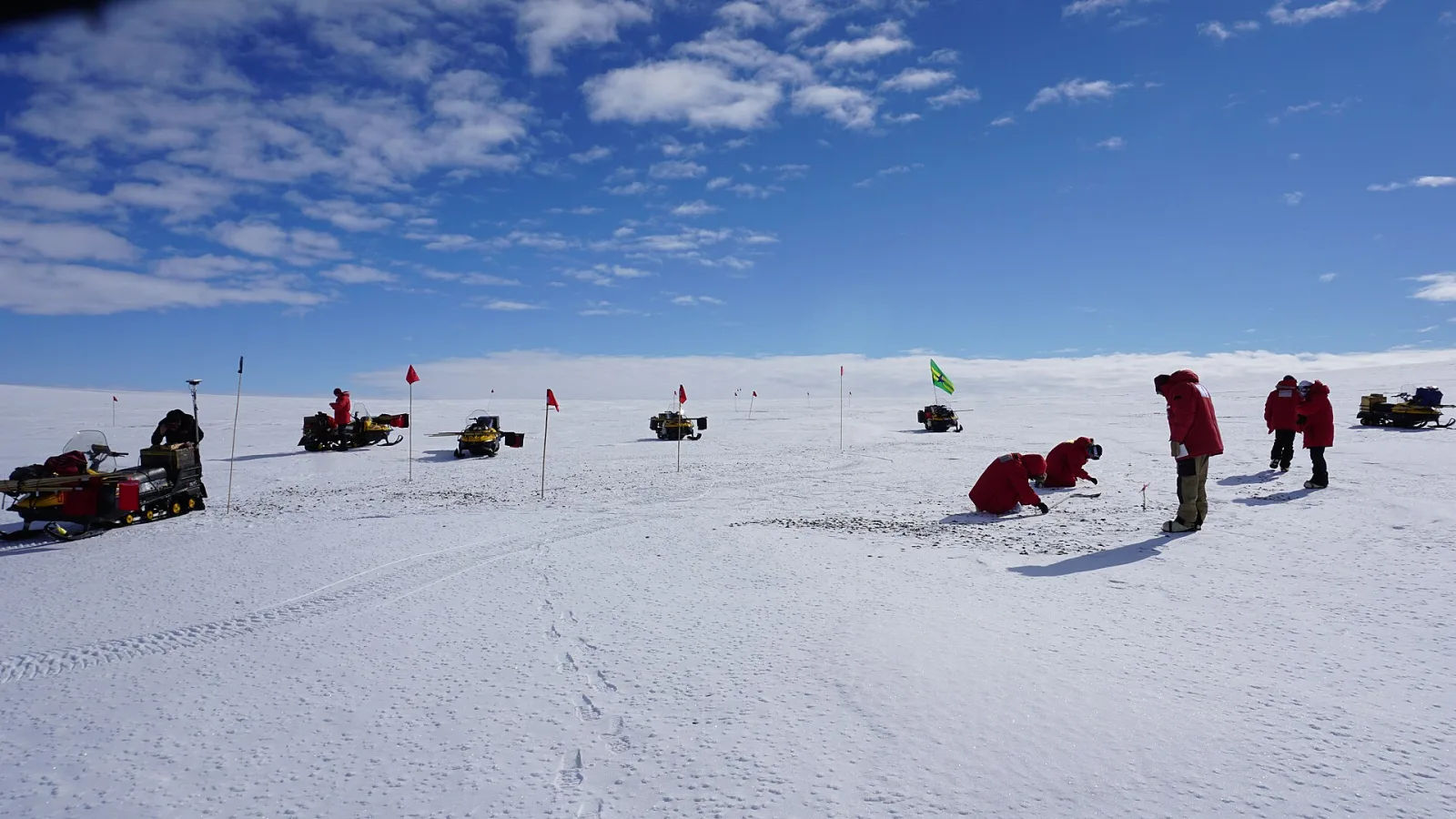
- Antarctic meteorites use a short code for the ice field and the field season year, plus a number. ALH 84001 is from the Allan Hills, collected in the 1984–85 season.
The record for each meteorite lists its class, its total known weight (TKW), whether it was a fall or a find, the year, the location and where the type specimen is held.
The most common classes in the database
Ordinary chondrites (H, L and LL, followed by a petrologic type from 3 to 6) make up most of the list. Only about 2.0% of entries in our copy are witnessed falls. The rest are finds, most of them from Antarctica and the hot deserts. For what the class letters mean, see the meteorite glossary.
Getting a new meteorite named
- Keep the find together, with its GPS location, photos and the date it was found (see meteorite hunting).
- Contact a classification lab, usually a university or museum meteorite group. The lab studies a sample and confirms the type.
- Deposit a type specimen. A required portion of the meteorite (often 20 g or 20% of the mass, whichever is less) goes to a recognised repository.
- The lab submits the data and proposed name to the Meteoritical Society’s Nomenclature Committee. Once approved, the meteorite appears in the Meteoritical Bulletin.
Frequently asked questions
What is the Meteoritical Bulletin Database?
It is the official list of every meteorite recognised by the Meteoritical Society, with each one’s name, class, mass, fall or find status, year and location. It is hosted by the Lunar and Planetary Institute.
How many meteorites are officially recognised?
More than 70,000 meteorites have approved names, and over a thousand new ones are added in a typical year, most of them from deserts and Antarctica.
What does NWA mean in a meteorite name?
NWA stands for Northwest Africa. It is used for meteorites found in the Sahara whose exact find location is not known, followed by a number, such as NWA 869.
Can I name a meteorite I found?
You can propose a name, but it must follow the Meteoritical Society’s rules. It is normally the nearest place name, and it is submitted through the lab that classifies the meteorite.