

What Is a Meteorite?
Meteoroids, meteors and meteorites explained, with the main types and where they come from.
Photo: Willamette Meteorite AMNH — User:Dante Alighieri, CC BY-SA 3.0, via Wikimedia Commons
A meteorite is a natural object from space that survives its fall through Earth’s atmosphere and lands on the ground. Most are pieces of asteroids. A few come from the Moon and from Mars. They are the oldest rocks you can hold, and most formed about 4.56 billion years ago, together with the Solar System.
Meteoroid, meteor, meteorite: what is the difference?
The same object gets a different name at each stage of its journey:
- Meteoroid: a rock or grain moving through space, from dust size up to about a metre across. Anything much bigger is usually called an asteroid.
- Meteor: the streak of light you see when a meteoroid hits the atmosphere at 11 to 72 km per second and heats the air around it. A very bright meteor is a fireball; one that explodes is a bolide.
- Meteorite: whatever is left that reaches the ground.
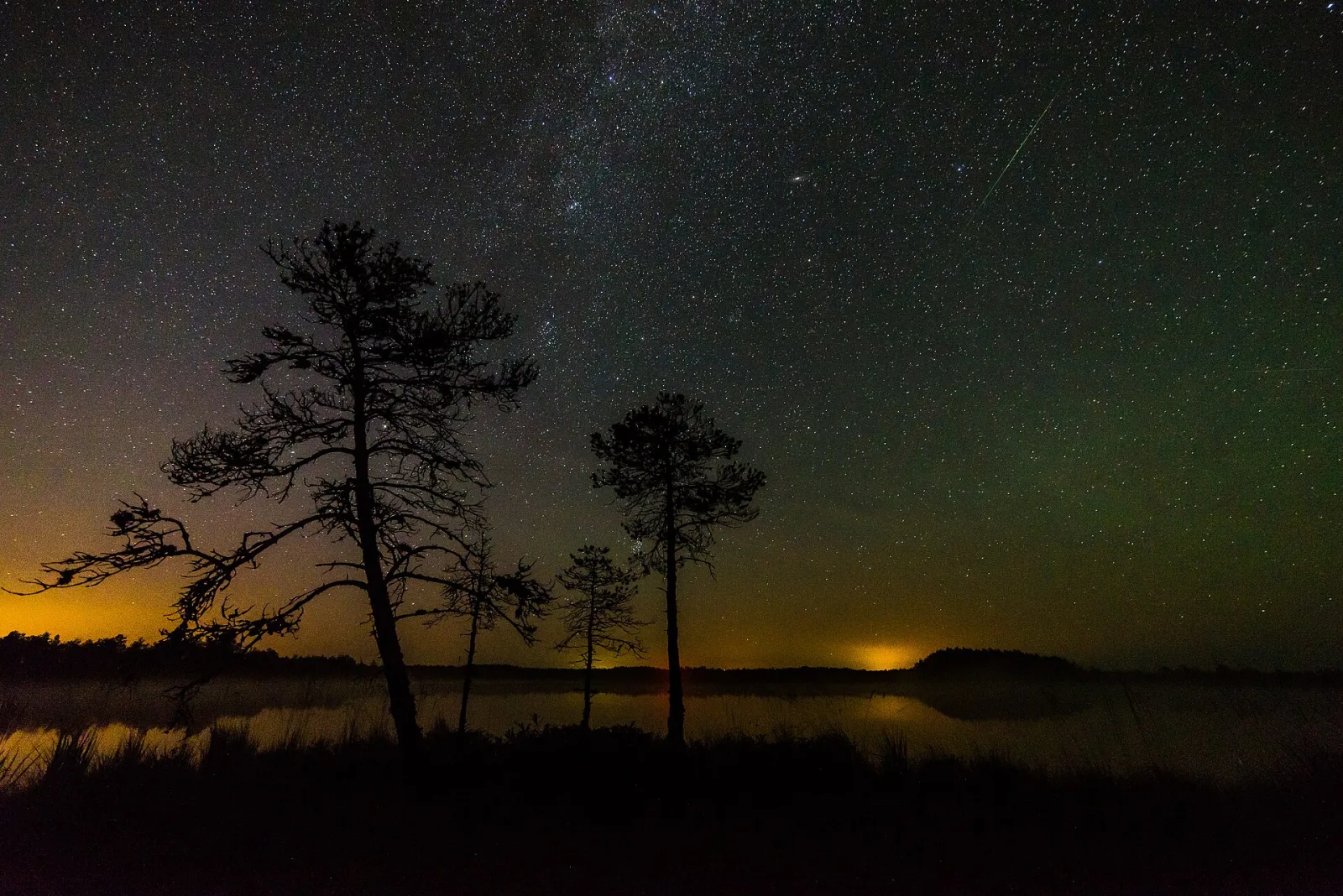
For every term from meteoroid to dark flight, and the yearly meteor showers, see meteor and meteorite facts.
Meteor showers such as the Perseids and Geminids almost never produce meteorites. Their particles are tiny and fragile. Meteorites come from larger, stronger rocks that arrive at random, on any night of the year.
Where do meteorites come from?
Nearly all meteorites are fragments of asteroids, most of them from the main asteroid belt between Mars and Jupiter. Collisions break pieces off. Gravity from Jupiter and slow heating by sunlight gradually nudge some of those pieces onto orbits that cross Earth’s.
A small number are blasted off larger bodies by impacts. Lunar meteorites come from the Moon and Martian meteorites from Mars. Gases trapped inside the Martian meteorites match the Martian atmosphere measured by spacecraft.
Earth collects tens of thousands of tonnes of extraterrestrial material every year. Almost all of it arrives as dust; only a small fraction reaches the ground as rocks large enough to find.
The three main types of meteorite
Stony meteorites
Mostly silicate minerals, like Earth rocks. They make up the large majority of meteorites seen to fall.
- Chondrites are packed with chondrules, tiny once-molten beads from the early Solar System. The ordinary chondrites (H, L, LL) are the most common meteorites of all. The carbonaceous chondrites (CI, CM, CV and others) hold water-bearing minerals and organic compounds.
- Achondrites were melted inside a planet or asteroid, so they have no chondrules. Examples include the HED meteorites from the asteroid Vesta, and the lunar and Martian meteorites.
Iron meteorites
Mostly iron-nickel metal from the cores of asteroids that melted and separated. When cut, polished and etched, many show the criss-cross Widmanstätten pattern, which only forms when metal cools over millions of years.
Stony-iron meteorites
Roughly equal parts metal and silicate. Pallasites hold olivine crystals in iron-nickel metal and are among the most beautiful meteorites. Mesosiderites are breccias of metal and rock fragments.


Falls and finds
A fall is a meteorite that was seen coming down and recovered soon after. Falls are fresh and valuable to science because they have barely weathered. A find is a meteorite picked up later with no record of its arrival. Most meteorites in collections are finds. They come mostly from hot deserts such as the Sahara, Oman and Atacama, and from the ice fields of Antarctica, where dark stones stand out and survive for a long time.
Today, camera networks, weather radar and eyewitness reports often let hunters work out where a fireball dropped its meteorites within days. The Meteorite World falls tracker follows new events as they happen.
What meteorites look like

A fresh meteorite usually has a thin, dark fusion crust, the glassy skin that forms when its surface melts during the fall. It can also show shallow thumbprint-like dents called regmaglypts. It is often heavier than an Earth rock of the same size because of its metal, and most meteorites will attract a magnet.
Over time on the ground, fusion crust weathers to brown and rusty. If you think you have found one, see how to identify a meteorite.
Why meteorites matter
- They record the birth of the Solar System. Calcium-aluminium-rich inclusions in some chondrites are the oldest dated solids, at about 4.567 billion years.
- Carbonaceous chondrites contain water and organic molecules, including amino acids. This helps scientists test ideas about how Earth got its water and the building blocks of life.
- Iron meteorites are samples of planetary cores, a part of a planet no one can ever visit directly.
- Lunar and Martian meteorites let scientists study those worlds without a sample-return mission.
Every new meteorite gets an official name from the Meteoritical Society. You can look them up in our meteoritical database.
Frequently asked questions
Is a meteor the same as a meteorite?
No. A meteor is the flash of light in the sky; a meteorite is the solid piece that reaches the ground. Most meteors leave no meteorite at all.
How old are meteorites?
Most formed about 4.56 billion years ago, at the very start of the Solar System, which makes them older than any rock that formed on Earth.
Are meteorites hot when they land?
Usually not. The fall heats only a thin outer layer, which ablates away, and the last part of the fall is slow, so most meteorites are cool or just warm when found. Some have even been reported with frost forming on them.
Are meteorites magnetic?
Most are. Irons, stony-irons and most chondrites contain iron-nickel metal and will attract a strong magnet. Some achondrites and lunar or Martian meteorites hold little metal and attract weakly or not at all.
What is the largest meteorite?
The Hoba iron meteorite in Namibia, estimated at around 60 tonnes, is the largest known single meteorite. It still lies where it was found.
Are meteorites radioactive or dangerous?
No. Meteorites carry only tiny traces of radioactive elements, similar to ordinary rocks, and are safe to handle. Use clean gloves or a clean bag on fresh finds to protect them, not you.